
Email Deliverability Consulting
For established businesses sending 1 million+ emails a month. We find out why email lands in spam, gets blocked, or stops performing, then help your team fix it on the platforms you already use.
Reach more of the audience you already have.
Audits, recovery, and ongoing optimization led by Luke Martinez, who designed SendGrid’s IP pool architecture.
A 30-minute intro call

What changed for our clients
3× the unique open rate for the platform's largest sender
The largest sender's unique open rate rose from 14% to 42%. We designed customer-level provisioning and guided reputation recovery; Google Postmaster IP reputation improved from Bad to Medium over two months.
AgentLoft
Read the case study →Eight users accounted for 85% of sending volume
The audit found that eight users drove 85% of the platform's sending volume, with many underperforming. We traced the problems across providers, domains, IPs, and accounts, then gave the team priorities for intervention.
ESP platform, anonymized
More total opens with 75% fewer emails
We changed audience selection and automated workflows, paused harmful sending, and guided recovery. Total recorded unique opens increased while sending volume fell by 75%, and Google domain reputation improved from Bad/Low to High.
Legacy Real Estate Team
Read the case study →Your email deliverability consultants
Work directly with email deliverability experts Luke and Alex.

Luke Martinez

Luke has 12 years in email deliverability, including 10 at SendGrid, where he ran deliverability and worked with its largest senders, including Uber, Booking.com, and Spotify. He designed the SendGrid Engagement Quality (SEQ) score and co-authored its patent. He leads audits, reputation recovery, and ongoing deliverability management at SH Consulting.

Alex Shakhov
Alex works on deliverability, DNS, authentication, and email security. He investigates configuration problems and domain abuse, and advises security and engineering teams on email and DNS security. His research on email and DNS abuse has been covered by Ars Technica, Dark Reading, and The Hacker News.
What clients say
★★★★★5.0 on ClutchMost deliverability consultants are oriented toward single-sender brands, and the dynamics on a shared platform are fundamentally different. Luke and the team clearly understood that distinction from the first conversation. Deliverables came in on the agreed timeline. No surprises, no slippage.

Luke previously ran deliverability at SendGrid, which means he knows that platform inside and out. They also actually do the work, not just tell you what to do. A lot of consultants will hand you a list of recommendations and disappear. These guys were with us to the end.

Email deliverability problems we solve
We work with SaaS, e-commerce, fintech, marketing businesses, and platforms that send for their customers. Smaller sending volumes can also be a fit when several platforms, brands, or domains make the setup complex.
Our focus is email to customers, subscribers, and users. We do not support cold outreach or purchased-list campaigns.
Delivered, but customers say it’s missing
A healthy delivery rate can sit alongside spam placement and weak engagement. We investigate performance by mailbox provider to find where the problem is concentrated.
Customer-critical email is blocked or late
Password resets, order confirmations, product alerts, and sales follow-ups need to arrive when they matter. We identify the affected streams and investigate the errors, blocklist listings such as SURBL, and reputation issues behind the disruption.
Several platforms share one reputation problem
Your CRM, marketing platform, product email, and business mail can use the same domain. We investigate authentication, platform dependencies, and unauthorized sending, including after an account or API key compromise.
A few customer accounts put the platform at risk
One account's sending can affect shared IP reputation. We identify which customers and message streams need attention, then help shape the policies and segmentation that protect healthy traffic.
A launch or migration puts delivery at risk
New domains, IPs, providers, and changes in volume need a coordinated rollout. We plan authentication, warm-up, suppression handling, and validation around the change.
You have an audience you no longer reach
Inactive subscribers represent an opportunity that needs careful handling. We help identify eligible contacts, test controlled re-engagement, and return responding subscribers to active mailing.
Email deliverability services

Email Deliverability Audit
For: Teams that need to know what is going wrong and what to fix first.
We review performance by mailbox provider (Gmail, Microsoft, Yahoo), domain, IP, and customer account, alongside SPF, DKIM, DMARC, sending patterns, and audience practices.
You get: A findings report, a ranked action plan, and a walkthrough with your team.

Email Deliverability Recovery
For: Active spam placement, blocking, or damaged sender reputation.
We identify what to pause, what can keep sending, and what needs to change. Then we help implement the fixes and manage a controlled recovery, including provider and blocklist mitigation when necessary.
You get: Hands-on remediation, a recovery sending plan, and progress tracking.

Deliverability Optimization
For: Teams that want help keeping email healthy as the business grows.
We monitor performance, review campaigns and automations, and help with segmentation, re-engagement, and infrastructure changes. Weekly or biweekly working sessions, with help between sessions.
You get: Regular reporting, clear priorities, and hands-on help with the changes.
The Email Deliverability Lifecycle
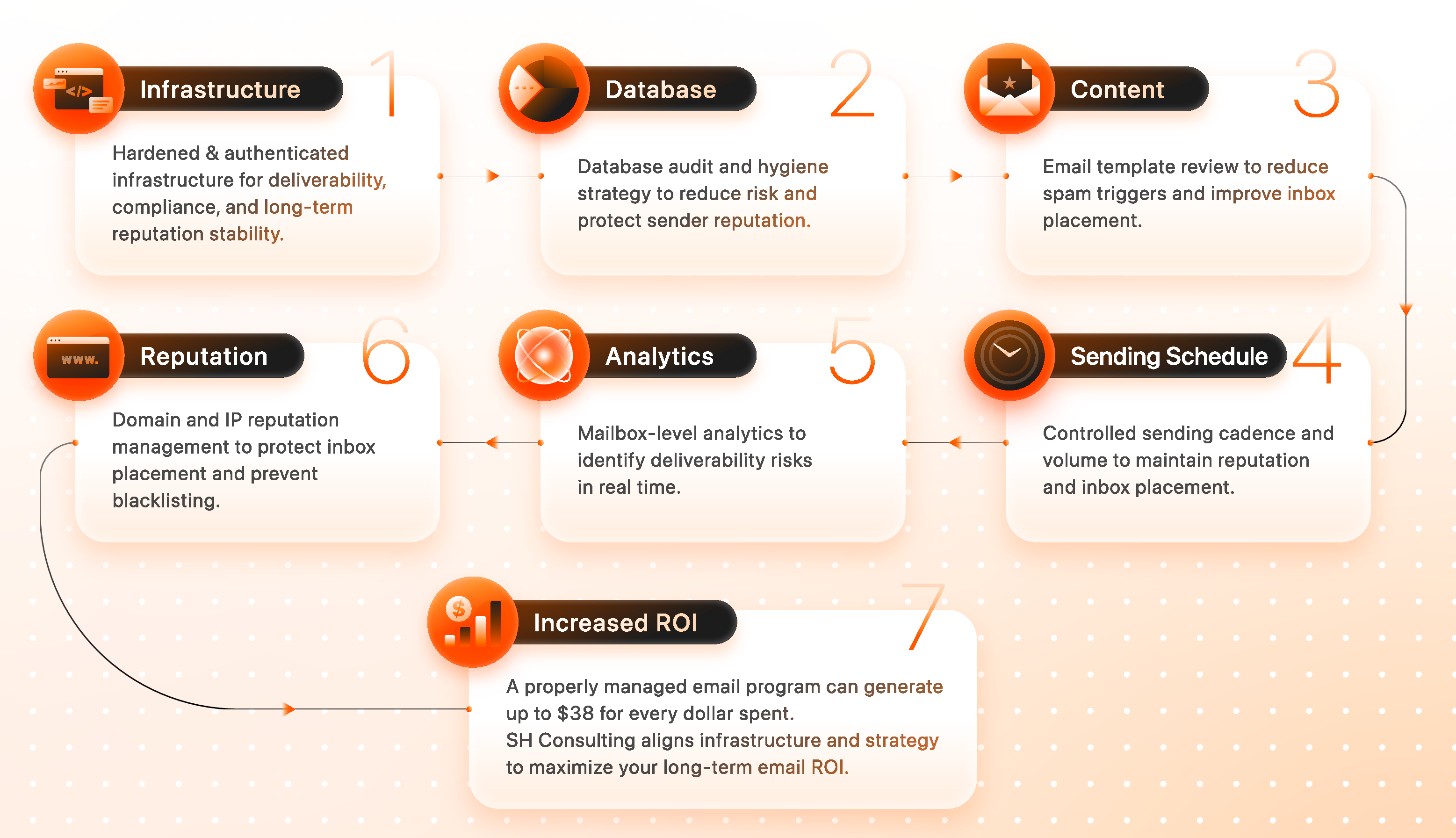
Swipe sideways to see all seven steps →
Our service covers the entire email lifecycle: infrastructure, database, content, sending schedule, analytics, reputation, and ROI. We look at how each part affects the rest of your email program.
How it starts
We agree on the scope and access in a call. Most engagements begin with an audit; an active incident starts with recovery priorities. Your team can act on the findings, or continue with us for implementation and ongoing optimization.
On the platforms you already use
We start with your existing setup. If a provider change would help, we explain why and plan the move with your team.
Frequently asked questions
Hiring and working with us
When should you hire an email deliverability consultant or agency?
When mail goes to spam, blocks keep returning, or the problem spans several providers and teams. We work alongside provider support, investigate across your CRM, product email, DNS, and sending infrastructure, and help your team make the fixes.
How soon can performance improve?
Some configuration fixes take effect quickly. Reputation recovery and re-engagement take longer. We agree on priorities and review points at the start, then track how your sending responds.
Can you guarantee inbox placement?
No. Mailbox providers decide where mail lands. We agree on the work, document the changes, and report what improves and what still needs attention.
Can you escalate to Gmail, Microsoft, or a blocklist for us?
Yes. We prepare the technical evidence, address the underlying cause, and use available provider or blocklist review routes. Where appropriate, we involve our industry contacts. The provider or blocklist operator controls its review and the outcome.
How does pricing work, and how do we start?
Start with a call about your platforms, volume, and the problem. We then propose the scope, responsibilities, and fee before work begins.
How do you measure the value of ongoing optimization?
We track blocking, reputation, clicks, replies, and relevant conversions against your starting baseline. Opens are a supporting signal because privacy tools and bots can inflate them. If cost per recorded open is useful, we divide the monthly fee by recorded opens over the same period, alongside those other measures.
Technical questions
Why are my emails going to spam?
Security, infrastructure, and sending patterns are common causes. An exposed API key can allow unauthorized sending; DMARC at p=none monitors authentication without requesting enforcement. A Spamhaus or SURBL listing can cause filtering or blocking at providers that use that list. Sudden volume spikes can also damage reputation.
What does an email deliverability audit include?
We review engagement by mailbox provider, IP and domain reputation, authentication (SPF, DKIM, DMARC, MTA-STS, TLS-RPT), content and sending patterns. A healthy 31% overall open rate can hide a 23% rate at Gmail. You get a report that ranks every problem by impact.
Why did my open rates drop after I verified my domain?
On some platforms, verification changes the sending domain or infrastructure your email uses. If that introduces a new domain or IP, sending full volume on day one can trigger filtering. We've seen open rates fall from 45% to 8% after this kind of change. A new sending domain or IP needs a gradual warm-up.
How fast can I increase my sending volume?
Start with your most engaged contacts at low volume and ramp up over one to two months. After that, grow by no more than 50% per send if you mail weekly, or 30% if you mail monthly. Jumping from 300 recipients to 1,000 in one send will put much of that campaign in spam.
Can warm-up or reputation fixer tools repair my reputation?
They usually make it worse. Mailbox providers recognize artificial engagement and penalize the sender for it. Reputation comes back only from real email to people who expect it.
Should I move DMARC to p=reject?
Yes, but not overnight. We've seen a company do it in one day and lock hundreds of its teams out of their marketing platforms. First identify every platform that sends as your domain, fix its alignment, then enforce in stages.
Tell us what's happening with your email
Tell us what you send, how much, and what needs to improve. We'll use the call to work out whether an audit, recovery, or ongoing optimization is the right place to start.

All consultations are confidential.